miniDSP: A Small C Library for DSP
I’ve been working on a small C library of DSP functions called miniDSP. It was born out of a need for simple, reusable lightweight components for audio processing tasks, without the overhead of massive frameworks. The library has grown quite a bit since I first wrote about it — here’s an updated overview of what’s in there now.
What is miniDSP?
miniDSP is a C23 library of essential digital signal processing tools, easy to integrate into any C project. It handles everything from spectral analysis and signal generation to DTMF decoding and live audio I/O. Full API reference and tutorials are at wooters.github.io/miniDSP.
What’s in the box?
The library is organized into a few logical areas. Each section links to its tutorial and API docs on the documentation site.
Frequency-domain analysis
The spectral analysis functions cover the fundamentals of frequency-domain work:
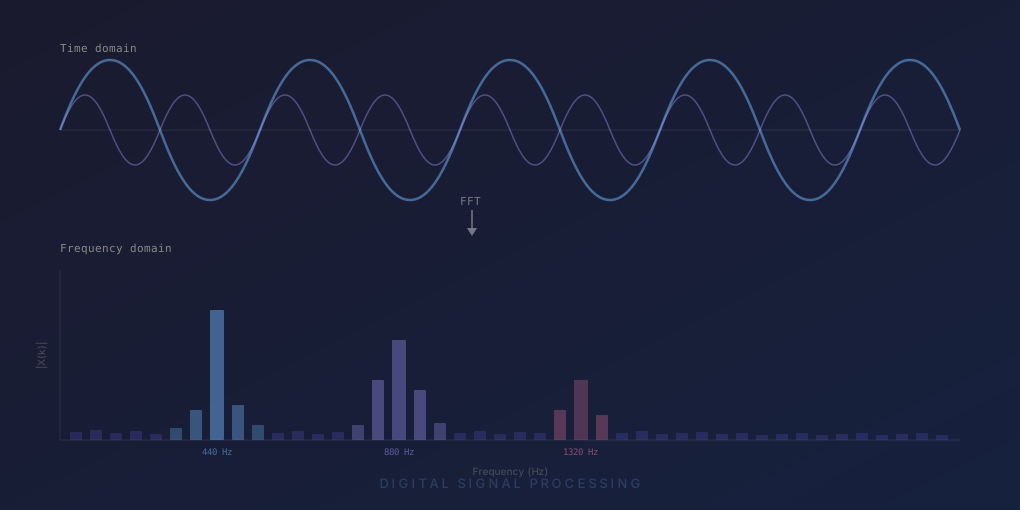
- Magnitude spectrum — |X(k)| from a real signal using FFT
- Power spectral density — periodogram showing how signal power distributes across frequencies
- Phase spectrum — arg(X(k)) in radians; prerequisite for phase-vocoder effects
- Spectrogram (STFT) — sliding-window FFT producing a time-frequency magnitude matrix
- Mel filterbank & MFCCs — perceptually-scaled features for speech and audio ML
- Window functions — Hanning, Hamming, Blackman, and rectangular windows
Signal generation
Generators for building test signals and demos: sine wave, white noise (Gaussian), impulse, chirp (linear and logarithmic), square wave, and sawtooth.
Filtering
Two filter families are included:
- Biquad filters (
biquad.h) — seven classic types based on Robert Bristow-Johnson’s Audio EQ Cookbook: low-pass, high-pass, band-pass, notch, peaking EQ, low shelf, and high shelf. - FIR filters & convolution — time-domain convolution, moving-average, general FIR, and FFT overlap-add for longer kernels.
Signal analysis & measurement
Functions for understanding what a signal is doing:
- RMS, zero-crossing rate, autocorrelation, peak detection, and signal mixing
- F0 estimation via autocorrelation and FFT peak-picking
- Energy, power (dB), normalized entropy, scaling, and automatic gain control
Effects
A handful of simple audio effects implemented as self-contained C functions: delay/echo, tremolo, and comb-filter reverb.
DTMF tone detection and generation
DTMF (Dual-Tone Multi-Frequency) is the signalling system used by touch-tone telephones. miniDSP includes:
- Multi-digit tone synthesis — generate DTMF sequences with configurable tone and pause durations
- Sliding-window FFT detection — decode digits from audio using a frame-based detector with an ITU-T Q.24-compliant state machine that enforces minimum 40 ms tone-on and 40 ms inter-digit pause timing
- Decoded digit output — each detected tone includes the digit character and onset/offset timestamps in seconds
Delay estimation
GCC-PHAT — estimate the time delay between two microphone signals using Generalized Cross-Correlation with Phase Transform. The core of acoustic source localization.
I/O
For reading, writing, and capturing audio:
- File I/O (
fileio.h) — read any format libsndfile supports (WAV, FLAC, AIFF, OGG, etc.); write WAV, NumPy.npy, or safetensors. - Live audio (
liveio.h) — record from the microphone and play back to speakers via PortAudio, with a non-blocking callback API.
Example
Generate a 440 Hz sine wave and find its peak frequency bin:
#include "minidsp.h"
#include <stdio.h>

int main(void) {
    double signal[1024];
    MD_sine_wave(signal, 1024, 1.0, 440.0, 16000.0);

    double mag[1024 / 2 + 1];
    MD_magnitude_spectrum(signal, 1024, mag);

    unsigned peak = 0;
    for (unsigned k = 1; k < 1024 / 2 + 1; k++)
        if (mag[k] > mag[peak]) peak = k;
    printf("Peak bin: %u (%.1f Hz)\n", peak, peak * 16000.0 / 1024);

    MD_shutdown();
}
There are 16 runnable examples in the examples/ directory, many of which produce interactive HTML plots (Plotly.js + D3.js) for exploring the output visually.
Documentation & Tutorials
The documentation site includes a Doxygen API reference and step-by-step tutorials covering:
- Signal generators — sine waves, white noise, impulse, chirp, and more
- Window functions — Hanning, Hamming, Blackman, and rectangular
- Magnitude spectrum — decomposing signals into frequency components via the DFT
- Power spectral density — measuring how power distributes across frequencies
- Spectrogram (STFT) — visualising frequency content over time
- Mel filterbank & MFCCs — perceptual features for speech and audio ML
- Phase spectrum — per-frequency phase angles
- Basic signal operations — RMS, zero-crossing rate, autocorrelation, peak detection, and signal mixing
- Simple effects — delay/echo, tremolo, and comb-filter reverb
- FIR convolution — time-domain and FFT overlap-add convolution
- Pitch detection — F0 estimation with autocorrelation and FFT peak picking
- DTMF — tone detection and generation with ITU-T Q.24 timing
Get It
Clone and build:
git clone https://github.com/wooters/miniDSP.git
cd miniDSP
make
This produces libminidsp.a in the repo root. Link against it with -lminidsp -lfftw3 -lm (add -lsndfile for fileio.h, -lportaudio for liveio.h).
Dependencies
| Library | Purpose | Debian/Ubuntu | macOS (Homebrew) |
|---|---|---|---|
| FFTW3 | Fast Fourier Transform | apt install libfftw3-dev | brew install fftw |
| PortAudio | Live audio I/O | apt install portaudio19-dev | brew install portaudio |
| libsndfile | Audio file reading/writing | apt install libsndfile1-dev | brew install libsndfile |
The Makefiles auto-detect Homebrew paths on macOS (both Apple Silicon and Intel). On Ubuntu, GCC 14 or later is required for C23 support.
Running tests
make test             # build and run all tests
make container-test   # run tests inside an Ubuntu 24.04 container (macOS only)
make docs             # generate API docs in docs/html
Full source, build instructions, and examples on GitHub: https://github.com/wooters/miniDSP