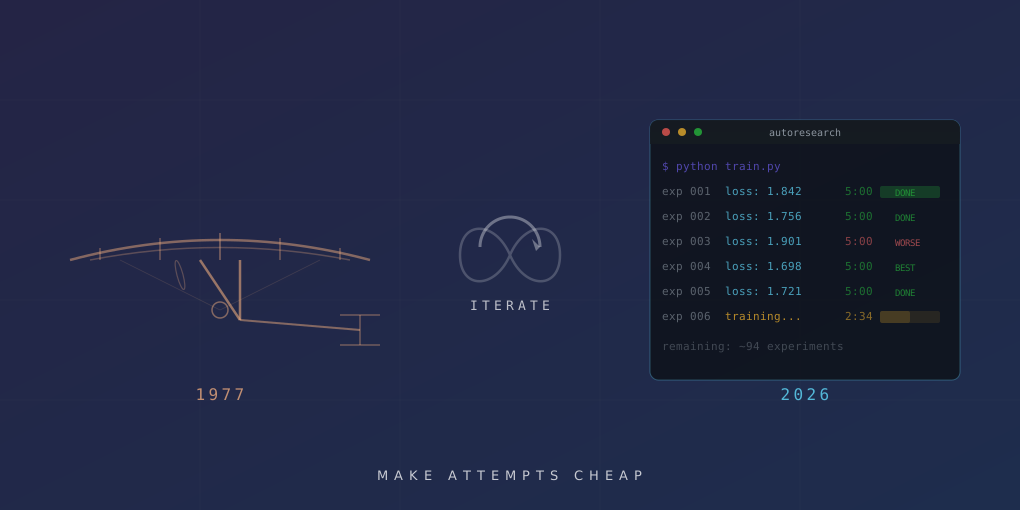
The Gossamer Condor Principle
A few weeks ago, Andrej Karpathy released autoresearch - a framework that lets an AI agent conduct ML research on its own. The setup is wonderfully simple: one GPU, one Python file, one metric. The agent modifies the training code, runs a 5-minute experiment, checks the result, and repeats. Leave it running overnight and you wake up to ~100 completed experiments.
When I first saw it, my mind didn’t go to transformers or training loops. It went straight to a story from 1977 - about an airplane made of Mylar and aluminum tubing that flew ten feet off the ground.
The Problem Nobody Could Solve
In 1959, a British industrialist named Henry Kremer offered a prize for human-powered flight - fly a figure-eight course around two markers half a mile apart, powered entirely by the pilot’s own muscles. That prize sat unclaimed for eighteen years.
It’s not like nobody tried. Well-funded teams with serious aerospace expertise took their best shots. They built meticulous, sophisticated aircraft using conventional structural principles. But here’s the problem - each attempt took months or years of work. A single crash could set a team back to square one. So teams obsessed over getting the flight right - the materials, the aerodynamics, the weight ratios. They were trying to nail it on the first try, because the cost of getting it wrong was catastrophic.
Nobody won. For eighteen years.
MacCready’s Reframe
Paul MacCready was not an airplane designer. He was an engineer and competitive sailplane pilot who, by his own account, “pretended he never saw an airplane before” when he started working on the problem. That inexperience turned out to be his biggest advantage.
MacCready didn’t ask “How do we achieve human-powered flight?” He asked a completely different question: “How do we build a plane that can be rebuilt in hours instead of months?”
That single reframe changed everything.
He built the Gossamer Condor out of Mylar, aluminum tubing, and wire. In his own words, it was an “ugly, dirty-looking, hang glider-type plane.” It flew at ten feet off the ground and ten miles per hour. It crashed constantly. But here’s the thing - after a crash, his team could patch it up and fly again the same day. Sometimes they’d fly three or four times in a single afternoon.
While other teams were spending a year between test flights, MacCready was running multiple experiments per day. Within six months, he won the Kremer Prize. A problem that stumped the world for nearly two decades - solved by a guy with Mylar and a fundamentally different question.
The Same Trick, Fifty Years Later
Karpathy’s autoresearch does exactly the same thing, just in a different domain.
Think about how traditional ML research works. You carefully design an experiment, allocate GPU hours, train for hours or days, analyze the results, form a hypothesis, and repeat. Each experiment is expensive - in compute, in time, in the researcher’s attention. So researchers naturally optimize each run, choosing architectures and hyperparameters carefully before committing resources. They’re building sophisticated sailplanes.
Autoresearch flips this with one hard constraint: every training run takes exactly five minutes. That’s it. The agent edits train.py, kicks off a run, and five minutes later it has a validation loss to compare against previous attempts. Bad idea? Cost five minutes. Move on. Good idea? Build on it. The single metric - validation bits-per-byte - makes every experiment directly comparable, no matter how wild the architectural change.
I love this part - the constraint is the innovation. MacCready’s constraint was materials so cheap that a crash cost hours, not months. Karpathy’s constraint is training so short that a bad idea costs five minutes, not five hours. Both sacrifice the quality of any individual attempt in exchange for sheer volume of attempts. Both win.
The Deeper Lesson
“Iterate fast” is probably the most common advice in technology. It’s also the most misunderstood. Most people hear it as “work faster” - type faster, review faster, ship faster. Hustle harder. But that’s not what MacCready did, and it’s not what autoresearch does.
They didn’t speed up the existing process. They redesigned the problem so that speed became a structural property of the system itself. MacCready didn’t build faster - he built cheaper. Karpathy didn’t train faster - he trained shorter. One is about effort. The other is about architecture. That’s a big difference.
I feel like this applies way beyond ML research or airplane design. When you’re stuck on a hard problem - really stuck, the kind where smart people have been failing for years - the instinct is to try harder or get smarter. MacCready’s lesson, echoed almost fifty years later by autoresearch, is to try a different question: What would make attempts so cheap that failure stops mattering?
Nearly Fifty Years Apart
The Gossamer Condor and autoresearch are separated by almost half a century. One is Mylar and aluminum tubing; the other is PyTorch and GPU clusters. But the principle underneath is identical - when you can’t predict which attempt will succeed, make attempts cheap and let volume do the work.
MacCready called his approach “the simplest thing that could possibly work.” Karpathy describes autoresearch as “one GPU, one file, one metric.” Same energy. Same insight. Same result.
References
- autoresearch - Karpathy’s autonomous ML experimentation framework
- How Nature and Naiveté Helped Paul MacCready Build a Human-Powered Airplane in Only Six Months - Signal v. Noise
- Gossamer Condor Use Case - AeroVironment